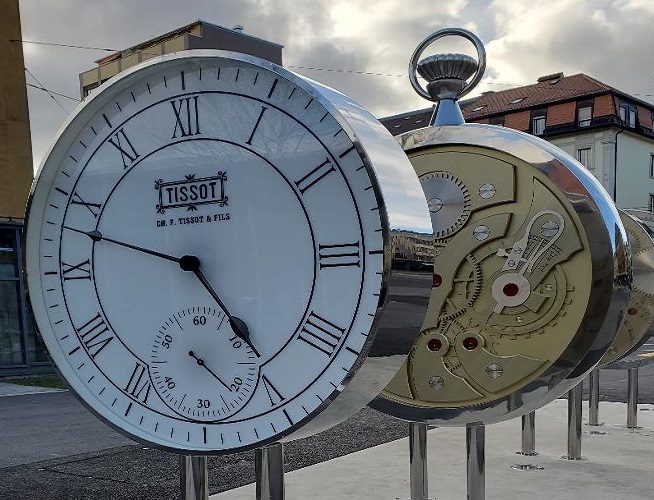
La Chaux-de-Fonds discreetly conceals its wealth, nestled slightly off the beaten tourist paths. Unveiling the charm hidden within its austere grid of streets can be a satisfying challenge. However, once you peel back this façade, you’ll step into a world where time unfurls like the intricate mechanisms of a finely crafted bevel-face chronograph. Swiss watchmaking enjoys legendary status, and the towns of Le Locle and La Chaux-de-Fonds are the beating heart of this horological heritage. Although Le Locle is notably smaller than its neighbor, La Chaux-de-Fonds, it mirrors the same urban structure and architectural aesthetics.



The origins of this rich horological heritage can be traced back to the mid-17th century in Le Locle. By the year 1870, approximately 4,500 individuals were directly engaged in the burgeoning clock-and-watch industry, comprising nearly half of the town’s total population.
In contrast, the growth of the Jewish community in La Chaux-de-Fonds began with the significant milestone of the 1857 abolition of restrictions on Jewish settlements. This marked the start of their presence and influence in the town’s history.
La Chaux-de-Fonds, at one point, was the residence of some of the most distinguished luminaries in the watchmaking industry. In the year 1900, it stood as the fourth most populous town in Switzerland, surpassed in Jewish population only by Zurich, Basel, and Geneva. These Jewish residents not only left an enduring legacy in the field of horology but also made remarkable and lasting contributions to the worlds of sports, arts, and culture.

Nestled within the breathtaking Jura Mountains of Switzerland’s Neuchâtel canton, La Chaux-de-Fonds graces the landscape not far from the French border. This remarkable city boasts the distinction of being the highest-elevation city in all of Europe, and it proudly holds the position as the fourth-largest French-speaking city in Switzerland. Perched on a plateau that soars to 1,000 meters above sea level, it has earned its place as one of the most remarkable UNESCO World Heritage Sites.
La Chaux-de-Fonds is renowned as a city intertwined with the art of watchmaking, a fact that I find particularly captivating. It’s aptly known as the “Watchmaking Town,” serving as the esteemed home to luxury watchmakers like Breitling, TAG Heuer, Omega, and Girard-Perregaux, alongside a myriad of supporting businesses that thrive in this horological hub.
Upon exploration, you’ll quickly notice that the city’s layout is meticulously planned, resembling the grid pattern of Manhattan in New York. Amidst this architectural symphony, you’ll encounter charming Swiss-style buildings, such as four-story apartment complexes adorned with windows on the upper floors. These windows served to illuminate the workplaces of watchmakers while also providing accommodation for skilled factory workers in a series of picturesque, colorful apartment buildings.
Wolfgang Carrier, affectionately known as “Wolfie” among the locals (a moniker he acquired during his time in New York City), proved to be the most remarkably knowledgeable tour guide I had the pleasure of encountering. His unique blend of expertise not only encompassed Jewish history but also extended to his fervent passion for watches and his valuable connections within the industry. This made him a truly exceptional guide.
In addition to Wolfie’s insights, Mr. Bertrand Leitenberg, the president of the Jewish Community, provided an extensive wealth of knowledge about Jewish history and the vibrant local community.

We are a close-knit community, mostly composed of seniors, with just a few children aged 6 to 10. According to Mr. Carrier, the majority of our members have Ashkenazi roots.
He shared with the New York Jewish Travel Guide that there are currently only about 70 Jews living in the entire Neuchâtel district. Our community has a stable membership with only a few new arrivals each year.
Mr. Carrier also shed light on the historical presence of Jewish families in this region, revealing that they were active in various businesses and seized the opportunity to establish themselves in the watch industry. The motivations behind Jewish immigration to this area make for a fascinating study. During that era, Jewish families, particularly from Alsace, held a remarkable 60% share in the watchmaking industry, exerting a significant influence on the growth of Swiss watchmaking akin to the impact of the Huguenots. By the turn of the century, in 1900, the Jewish community in La Chaux-de-Fonds had grown to approximately 1,000 members. Mr. Carrier noted that “in 1850, the lace industry, not watchmaking, was the dominant trade in Le Locle, which boasted 3,000 residents, including 430 watchmakers and 750 lace makers.”
In these two towns, with a combined population of around 50,000, a staggering 14,000 individuals commute daily from nearby French towns to work in the watchmaking industry and related services. The lure of higher wages, often triple those across the border, attracts them here. However, within the broader Swiss watch industry, which employs approximately 60,000 individuals, around 25,000 of them reside in our region. It is estimated that 6,000 to 7,000 of these workers hail from France.

Mr. Leitenberg further elaborated on the size of our Jewish community in this region, stating, “We have only one synagogue, and Rabbi Michel Margulies from Alsace has faithfully served our community for over 30 years.” While we’ve been welcoming Sephardic Jews who arrived in the 1970s, our community predominantly consists of Ashkenazi members.
From 1960 to 1973, our community was privileged to have Rabbi Isaac Roush from Morocco as one of our spiritual leaders. Rabbi Roush maintained extensive connections with Jewish communities in Lausanne, Geneva, and Bern. Today, our synagogue warmly welcomes everyone to our Passover Seder, regardless of whether you follow Orthodox or Conservative traditions.
Our cuisine is consistently kosher, carefully prepared by an experienced Israeli chef who has previously run an Israeli restaurant. All meat is sourced from Lausanne, less than an hour away, and is rigorously supervised by our Rabbi to ensure strict adherence to halacha (Jewish law).
The population of La Chaux‑de‑Fonds has gradually declined over the years due to several factors, including rising taxes, long winters with heavy snowfall, and changes in the labor market as machinery gradually replaces manual work in local industries.
Despite this demographic decline, tourism in La Chaux‑de‑Fonds has been on the rise. Visitors from across Europe, as well as journalists and media professionals, are drawn to the city to explore its watchmaking heritage, admire its distinctive Art Nouveau architecture, and visit “La Maison Blanche,” the birthplace of renowned architect Le Corbusier in 1887. This architectural landmark attracts tourists and architects alike, particularly from Japan and the United States. Additionally, the region’s winter sports offerings—including cross-country and downhill skiing—bring a steady stream of Swiss visitors seeking outdoor recreation.

Built 125 years ago, this Neo-Romanesque brick synagogue remains an active place of worship and was the largest of its kind in Switzerland at the time of its inauguration in 1896. An iconic Swiss landmark, it underwent careful restoration in 1981–1982. The synagogue was designed by the same Alsatian architect who created the renowned Strasbourg synagogue in France, making it a true architectural masterpiece.
At its main entrance, one can prominently find the words: “Hear, Israel, the Eternal is our God; the Eternal is One.” The façade is characterized by the prominent display of the two tables of the law, while the arches are adorned with meticulously crafted decorations, painted against a backdrop of radiant gold. These artistic elements are enriched by the Hebrew inscription, which eloquently states, “The fear of the Lord is the beginning of wisdom.” According to Mr. Leitenberg, there are plans to name the street outside the synagogue “Le Parvis du Grand Rabin Wolff” in tribute to Rabbi Jules Wolff, who dedicated his faithful service to the community from 1896 to 1955.
The community takes great care in maintaining the synagogue, and government assistance is sought exclusively for significant renovations, such as the replacement of the roof when they are deemed essential. Being accessible to non-Jewish visitors, it attracts numerous individuals who come to appreciate its beauty, delve into its rich history, and grasp its profound significance. Regrettably, many of the younger generations are unaware of the existence of such a magnificent synagogue in this town.

Today, in La Chaux-de-Fonds, antisemitism is nearly non-existent. However, Mr. Woolfe noted that in the past, there were significant tensions between Jewish and non-Jewish watchmakers. Fierce competition occasionally led non-Jewish watchmakers to call for the expulsion of their Jewish counterparts.
Our next visit was to “The Israelite Cemetery,” founded in the commune of Les Eplatures in 1872. What sets this Jewish cemetery apart from non-Jewish cemeteries is its absence of Judaic symbols and secular ornamentation. Despite the dwindling number of Jews in the area and the decreasing frequency of funeral ceremonies, the cemetery remains in use.
Mr. Leitenberg explained, “We are still able to bury Jewish individuals in this cemetery.” He also mentioned that there is a designated area nearby for non-Jews who wish to be buried alongside their Jewish family members. For example, if a Jewish woman has a husband who is not of the Jewish faith but is actively involved in the community, there is a clearly defined space for them. Thanks to the support of several contributors, the cemetery is kept in excellent condition and well-maintained.
If you’re passionate about architecture or 19th-century urban design, La Chaux-de-Fonds should definitely be on your Swiss travel itinerary.
Le Corbusier’s La Maison Blanche: In 1902, Charles Edouard Jeanneret, later known as the renowned architect Le Corbusier, began his career as an engraver at the local art school. After collaborating on various projects with architect René Chapallaz, he established his own firm and designed La Maison Blanche, also known as “The White House,” for his parents in 1912. The Association Maison Blanche acquired this house in 2000 and opened it to the public in 2005. Today, it operates as a heritage museum, showcasing period furnishings. It is a must-visit for architecture enthusiasts, offering valuable insights into Le Corbusier’s early works and architectural evolution. In 1917, he went on to build La Villa Turque, or “The Turkish Villa,” for the prominent Jewish watchmaker family, the Schwobs, before relocating to Paris.
La Chaux-de-Fonds has earned recognition from Switzerland Tourism as one of the eight most significant cities on the Art and Architecture Theme Route, thanks to its exceptional architectural heritage.

Blending the elegance of Art Nouveau with the boldness of Art Deco, La Chaux‑de‑Fonds showcases breathtaking architectural gems. Its streets are alive with intricate Art Nouveau details—from beautifully crafted stairwells and stained-glass windows to ornate balconies and delicate Sapin-style embellishments seamlessly woven into the city’s buildings. A charming highlight of our visit was spotting a Star of David subtly integrated into a mural on a stairwell of one of these Art Nouveau residences.
Spending a few days exploring La Chaux‑de‑Fonds is a must for anyone fascinated by Switzerland’s watchmaking heritage and eager to admire the stunning homes and architectural masterpieces created by its celebrated architects.
Meyer Harroch is the founder of the New York Jewish Travel Guide, documenting Jewish heritage, life, and culture around the world.
Special thanks to the Swiss Tourism Office and to Divine Bonga, of Switzerland Tourism North America, for their hospitality
For those planning a trip to Switzerland, reach out to Switzerland Tourism or visit their website at myswitzerland.com.
For more information on La Chaux-de-Fonds and the Swiss watchmaking industry, contact Mr. Wolfgang Carrier at carrierwf@bluewin.ch.
Explore More Jewish Heritage in Switzerland
Enjoyed La Chaux‑de‑Fonds? Subscribe to the New York Jewish Travel Guide for insider tips and travel guides. Discover Bern, Zurich, Geneva, Lugano, St Moritz, and Lucerne’s historic synagogues, cultural landmarks, and vibrant Jewish communities. Start planning your next heritage adventure today!