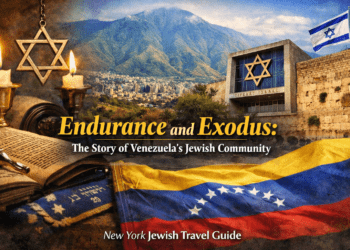
For much of the 20th century, Venezuela was seen as a place of promise for Jews fleeing hardship elsewhere. Welcoming immigration policies, economic opportunity, and relative social stability allowed Jewish families—many from Eastern Europe, North Africa, and the Middle East—to put down roots and build vibrant communal life. Caracas, in particular, became home to a thriving Jewish population whose institutions reflected both tradition and integration into Venezuelan society.



Today, that community is a fraction of what it once was—but it has not disappeared.
A Once-Flourishing Community
At its height, Venezuela’s Jewish population numbered more than 20,000, anchored by synagogues, day schools, youth movements, social clubs, and charitable organizations. Jewish businesses and professionals played visible roles in the country’s economic and cultural life.
Jewish identity in Venezuela was both proudly maintained and outward-looking. Hebrew education, Zionist youth groups, and strong ties to Israel coexisted with deep engagement in Venezuelan civic life. Many Venezuelan Jews recall a time when antisemitism was rare and Jewish life was openly celebrated.
Rising Antisemitism and an Era of Fear
That sense of security began to erode in the late 1990s and early 2000s. Political radicalization, anti-Israel rhetoric from the state, and growing instability coincided with a sharp rise in antisemitic incidents. Synagogues were vandalized, Jewish institutions were surveilled, and inflammatory rhetoric became increasingly normalized in public discourse.
These developments did not occur in isolation. They were part of a broader national unraveling marked by economic collapse, hyperinflation, crime, and the breakdown of public services. But for Jews, the atmosphere carried an added layer of vulnerability—one rooted in history and collective memory.
Fleeing Venezuela
As conditions deteriorated, Venezuelan Jews began leaving in large numbers. Entire families relocated, often with little more than what they could carry. Israel, the United States, Panama, Mexico, and Spain became major destinations, with Miami and Tel Aviv emerging as particularly significant hubs of the Venezuelan Jewish diaspora.
This exodus was not merely economic; it was existential. Parents worried about the future of Jewish education. Community leaders feared the slow disappearance of institutions built over generations. By the mid-2010s, the population had dwindled dramatically.
Today, only about 4,000 Jews remain in Venezuela.
Jewish Life Still Goes On
Despite the decline, Jewish life in Venezuela continues—quietly, determinedly, and with remarkable resilience.
There are still approximately 18 synagogues, schools, and Jewish charitable organizations operating across the country, primarily in Caracas. Communal structures have adapted to smaller numbers, but they remain deeply committed to maintaining religious observance, education, and mutual support.
Shabbat is still welcomed. Jewish holidays are still observed. Children still learn Hebrew and Jewish history, even as classrooms grow smaller.
Notably, even in the absence of diplomatic relations between Venezuela and Israel, the Jewish community remains strongly Zionist. Support for Israel—financial, cultural, and emotional—continues to be a defining feature of Jewish identity for those who stayed, as well as for those who left.
A Diaspora That Remembers
For Venezuelan Jews abroad, memory plays a powerful role. Community events, synagogue minyanim, and family traditions carry the accents, flavors, and melodies of a homeland left behind. Arepas sit alongside challah; Spanish mingles with Hebrew and Ladino; stories of Caracas are passed to children who may never have seen it.
The Venezuelan Jewish story is now both local and global—rooted in a country that shaped generations, and carried forward by a diaspora determined not to forget.
Looking Ahead Amid Uncertainty
In recent days, dramatic political developments involving President Nicolás Maduro have once again placed Venezuela in the global spotlight.
For Venezuela’s Jewish community—both those who remain and those watching from afar—the hope is simple yet profound: a future defined by safety, dignity, and the freedom to live openly as Jews.
Whatever political changes may come, the story of Venezuela’s Jews is already one of extraordinary endurance—a testament to faith, adaptability, and the unbreakable bonds of community, even in the face of exile.
By New York Jewish Travel Guide Staff