


To be a Moroccan Jew in the 21st century is not simply to remember Morocco—it is to live Morocco through faith, sound, food, memory, and community. Even thousands of miles from Fez, Marrakesh, or Tangier, Moroccan Jews carry a civilization with them. In Brooklyn, Paris, Montreal, Ashdod, and Los Angeles, their homes and synagogues continue to echo with the rhythms of North Africa and medieval Spain, preserved not in museums but in daily life.

Moroccan Jewish religious practice is itself a living archive. Prayer is sung rather than spoken, shaped by Andalusian musical modes that date back to medieval Spain and North Africa. Each Shabbat and festival carries its own emotional tone, expressed through melodies that evoke longing, joy, repentance, or celebration. Torah is not only read; it is chanted in ancient cadences that bind generations together. Even today, Moroccan synagogues across the diaspora preserve these prayer traditions, allowing worshippers to feel connected not only to Jerusalem but to Fez and Meknes as well.
Alongside formal prayer, Moroccan Jews maintain a deeply spiritual folk tradition centered around revered rabbis and saints. Annual hillulot—commemorations of figures such as Rabbi Amram Ben Diwan, Rabbi David u-Moshe, and Rabbi Haim Pinto—bring together families, music, candle-lighting, storytelling, and festive meals. These gatherings transform memory into lived experience, reminding younger generations that holiness is not only found in books but in shared community and inherited devotion.
Music remains one of the most powerful expressions of Moroccan Jewish identity. Rooted in Andalusian classical tradition and enriched by Hebrew poetry, Arabic modes, and Berber and Spanish influences, Moroccan Jewish music is among the most sophisticated in the Jewish world. In the 21st century, it is enjoying a remarkable revival, with young Moroccan Jews in Israel, France, and the United States rediscovering ancient piyutim and bringing them to new audiences in concert halls, synagogues, and cultural festivals.
The same continuity lives in the kitchen. Moroccan Jewish cuisine is far more than food—it is memory made edible. On Shabbat, dafina slowly cooks overnight, filling the home with the scent of cumin, chickpeas, caramelized onions, and tender meat, just as it did centuries ago in Moroccan mellahs. After Passover, families celebrate Mimouna by opening their doors and serving mofletta, honey, and dates, symbolizing sweetness, abundance, and renewal. In the diaspora, these traditions have become a public declaration of identity, with Moroccan Jewish cuisine now featured in kosher restaurants, community festivals, and family tables worldwide.

The Manhattan Sephardic Congregation: A Living Center of Moroccan Jewish Life
At the heart of Moroccan Jewish life in New York stands the Manhattan Sephardic Congregation (MSC). While primarily a synagogue, MSC also serves as a center for preserving Moroccan Jewish heritage through prayer, education, and community programs. Its services protect authentic Moroccan melodies. Its holiday celebrations recreate the rhythms of Fez and Casablanca. Its educational programs teach Judeo-Moroccan traditions and Jewish history to new generations. For Moroccan Jews across America, MSC is a spiritual home and a cultural lighthouse.
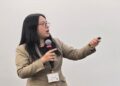
Under the leadership of Rabbi Raphael Benchimol, MSC has also become a bridge between the Moroccan Jewish past and its global future. Rabbi Benchimol has devoted decades to preserving Moroccan Jewish heritage, not only through prayer and education in Manhattan, but also through his tireless efforts to restore Jewish cemeteries and sacred sites throughout Morocco. In recognition of this extraordinary work, King Mohammed VI of Morocco awarded him the Knight of the Order of the Throne, one of the Kingdom’s highest honors, in a ceremony held in Manhattan. During the event, Rabbi Benchimol presented a silver Torah crown to the Kingdom of Morocco, symbolizing the enduring spiritual bond between Moroccan Jewry and the Moroccan monarchy. He continues to serve as rabbi of MSC and is the author of several important works on Moroccan Jewish tradition.
Family storytelling remains a cornerstone of Moroccan Jewish identity. Around Shabbat tables and holiday meals, families share stories about cities they left behind, revered rabbis, saintly figures who once protected their ancestors, and the journeys that carried them from Morocco to Israel, France, and America. These memories weave a living tapestry of belonging, giving younger generations a powerful and enduring connection to their roots
In today’s global world, Moroccan Jews often carry multiple identities at once—American, Israeli, French, or Canadian—yet remain deeply Moroccan. This dual heritage is not a contradiction but a strength. Through music, cuisine, prayer, and communal life, Moroccan Jews continue to celebrate a civilization that has survived centuries of change without losing its soul.
To be a Moroccan Jew in the 21st century is to live inside a story that never ended. It is to pray with melodies older than nations, to cook recipes older than passports, and to sing poetry that once echoed through the courtyards of medieval Spain and North Africa. Whether in New York, Jerusalem, Paris, or Casablanca, Moroccan Jews continue to show that heritage endures when people cherish it—it travels, adapts, and survives across generations
By Meyer Harroch, New York Jewish Travel Guide

Meyer Harroch is the Founder and Publisher of the New York Jewish Travel Guide, documenting Jewish heritage, life, and culture worldwide while promoting tourism and global destinations.



After reading your article I felt like I had been oriented into a very positive view of what it is to be a Moroccan Jew in the 21st century. Rabbi Benchimol led me further into reviewing everything from Jewish Heritage and traditions so
I felt he had offered me everything else I needed to know about Moroccan Jewish life. It is a tradition I hope will not fade and that there will always be new ways it will adapt to all life cycle.
thanks for bringing all this information to my attention.
Judy