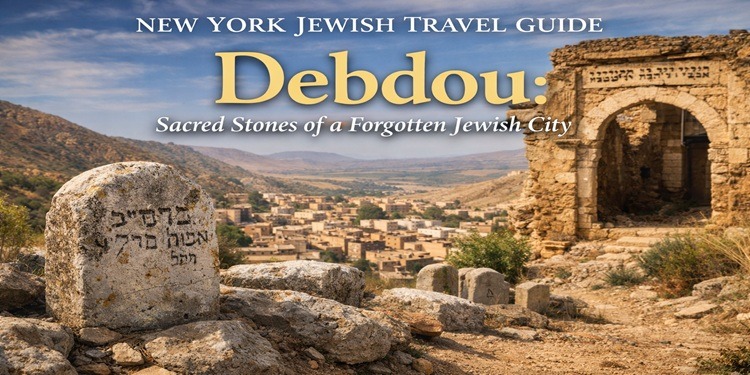
Tucked into the rugged hills of northeastern Morocco lies Debdou, a small town with a remarkably large place in Jewish history. Far from Morocco’s better-known Jewish heritage cities, Debdou offers something quieter and more intimate — the story of a community that once flourished in spiritual depth, scholarship, and tradition.



For centuries, Jewish families formed the heart of this mountain town. Synagogues dotted the mellah, rabbis and scholars shaped religious life, and Sephardic traditions carried from Spain found new roots in Moroccan soil. Though the Jewish population departed in the mid-20th century, Debdou remains a powerful destination for heritage travelers. Its stones, pathways, and hilltop cemeteries preserve the echoes of a vibrant Jewish world that once thrived here against a backdrop of desert winds and wide Moroccan skies.
Roots of a Community: From Sepharad to the Moroccan Hills
The Jewish presence in Debdou traces back to refugees fleeing Spain’s anti-Jewish violence of the late 14th century, particularly families such as the Cohen-Scali and Murciano clans, who established deep religious and civic roots here.
Unlike most Moroccan towns where Jews were a minority, Debdou was exceptional. At certain points in the 19th and early 20th centuries, Jews formed a substantial portion — and in some accounts even a plurality — of the town’s population.
For generations, this community was a center of Jewish learning and ritual life in the region, maintaining numerous synagogues, study houses, and a rich tapestry of spiritual practice.
Synagogues of Debdou — Houses of Gathering
Though many of Debdou’s synagogues now stand in ruin or have disappeared entirely, historical records and local memory point to dozens of prayer spaces once scattered throughout the mellah — the Jewish quarter. Some accounts suggest that as many as 17 distinct synagogues existed here, speaking to the vibrancy of religious life in the community’s heyday.
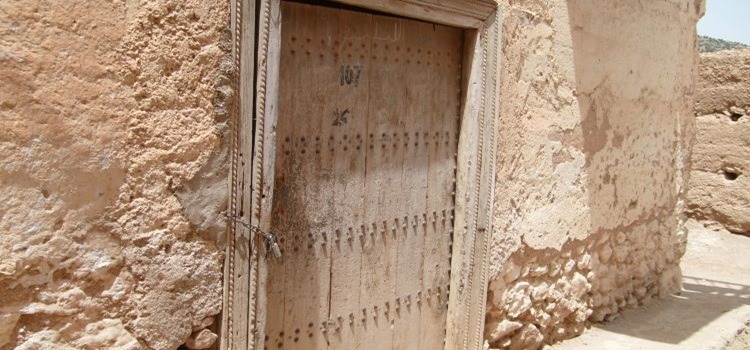
At various points in the mellah, crumbling stone archways and threshold stones hint at former houses of worship where Torah was read, and community prayers were said. These architectural traces — often subtle and unmarked — are treasures for travelers who take the time to walk Debdou’s narrow lanes and listen for history in every stone.
Old Jewish Cemetery — Millennium of Memory
A short climb up the hills above the town leads to Debdou’s ancient Jewish cemetery, with graves that may date back more than 900 years. Simple, unadorned stone markers reflect longstanding Jewish tradition and the deep roots of the community here.
Just above it lies the newer cemetery, established in the early 20th century and containing tombstones from the 1900s through the 1950s. Many of these stones are engraved with Hebrew or Spanish inscriptions that speak to the community’s layered cultural and linguistic heritage.
Moroccan Jews still climb these paths to honor ancestors and revered figures, maintaining the sacredness of these hillside burial grounds.
Legends, Saints, and Oral History
Local tradition preserves the memory of Jewish saints and respected scholars buried here, whose tombs draw pilgrims during annual hiloula celebrations — commemorations that blend prayer, song, and community remembrance.
Debdou’s heritage is part of a broader tapestry of coexistence between Muslim and Jewish neighbors, reflected in shared stories, mutual respect, and enduring connections that lasted well into the mid-20th century.
Preservation and Cultural Memory
Recent cultural initiatives have sought to document and protect these sites and the history they represent. Local plans — including proposals for a Maison de la Culture dedicated to Debdou’s Jewish heritage — underscore the importance of preserving this legacy for future generations.
Travel Tips & Respectful Exploration
Visiting the Jewish Sites of Debdou
Best Time: Spring and fall for comfortable hiking weather.
Guided Visits: Local guides familiar with the mellah and cemetery paths can enrich your experience.
Respect Traditions: These are active pilgrimage sites; dress modestly and ask permission before photographing graves.
Cultural Context: Engage with community custodians to deepen your understanding of Debdou’s heritage.
Suggested Itinerary:
Morning: Walk the old mellah and explore synagogue ruins.
Midday: Visit hillside cemeteries and tombs of saints.
Afternoon: Connect with local narrators or visit nearby Oujda for a broader regional context.
Today, visiting Debdou is not about grand monuments or restored landmarks. It is about presence — and memory. The remains of synagogues, the narrow lanes of the former mellah, and the hillside cemeteries together tell the story of a community whose spiritual life once defined the town.
For travelers exploring Jewish life around the world, Debdou offers a rare opportunity to encounter history in its most authentic form. Here, heritage is not curated behind glass — it is woven into the landscape itself. Walking these quiet streets and sacred hillsides connects visitors to centuries of faith, resilience, and continuity, reminding us that even in the most remote places, Jewish life once flourished and its legacy still endures.
By New York Jewish Travel Guide Staff