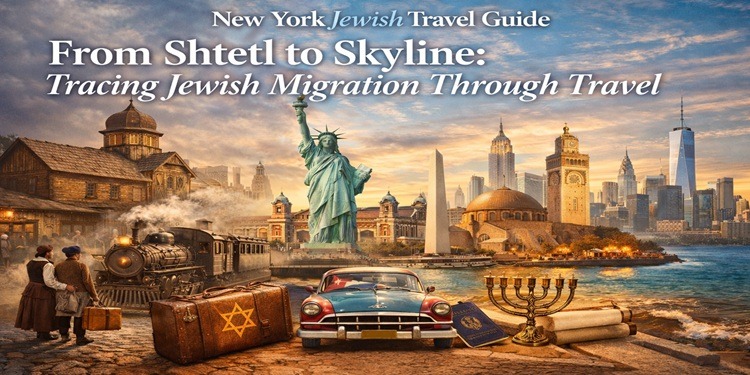
Jewish history is not only written in books—it is written on roads, in ports, across oceans, and along railway tracks. From humble shtetls in Eastern Europe to towering skylines in New York, Buenos Aires, and beyond, Jewish migration shaped not only communities but entire cities.



Today, travelers can follow these powerful migration routes. In doing so, they rediscover resilience, reinvention, and renewal. Whether you are a senior retracing family roots, a history lover seeking context, or a family teaching the next generation, this journey offers meaning at every stop.
Let us travel—from shtetl to skyline.
From the Shtetl to the New World
In the late 19th and early 20th centuries, millions of Jews fled pogroms, poverty, and persecution in Eastern Europe. They left villages in Poland, Lithuania, Ukraine, and Russia carrying little more than faith, family photographs, and prayer books. Their destination was often America.
For many, the first glimpse of freedom appeared at Ellis Island in New York Harbor. Between 1892 and 1954, over 12 million immigrants passed through its inspection halls. Jewish families endured medical exams, legal questioning, and the anxiety of possible rejection. Yet for most, the gates opened.
Today, visitors can explore interactive exhibits, examine ship manifests, and stand beneath the vaulted ceilings of the Registry Room. As a result, history feels immediate and personal. It is not abstract is human.
However, arrival was only the beginning.
The Lower East Side: America’s First Jewish Laboratory
After processing, many immigrants settled just across the East River in Manhattan’s densely packed tenements. The Lower East Side quickly became a laboratory of Jewish-American life.
Here, Yiddish theaters flourished along Second Avenue. Labor movements grew out of sweatshops. The 1911 Triangle Shirtwaist Factory fire reshaped workplace laws and highlighted Jewish immigrant activism. Moreover, pushcart markets turned Orchard and Hester Streets into open-air bazaars.
Travelers today can step inside the historic apartments of the Tenement Museum, where guided tours vividly recreate the daily lives of immigrant families who once crowded these narrow streets with hope and hardship. Just blocks away, the restored sanctuary of the Eldridge Street Synagogue—a masterpiece of Moorish Revival architecture—stands as a symbol of faith, perseverance, and communal pride, its stained glass and hand-painted ceilings reflecting both beauty and determination. Meanwhile, the legendary Katz’s Delicatessen continues to serve towering pastrami sandwiches and time-honored recipes, preserving the flavors and culinary traditions that immigrants carried across the Atlantic and embedded into New York’s cultural fabric.
As you walk these streets, you see more than brick and mortar. You see ambition. You see adaptation. You see how the skyline of modern New York rose from immigrant courage.
Jewish Havana: Resilience in the Caribbean
Not all Jewish migration flowed north. In the 1920s and 1930s, Jews fleeing Europe found temporary—and sometimes permanent—refuge in Cuba.
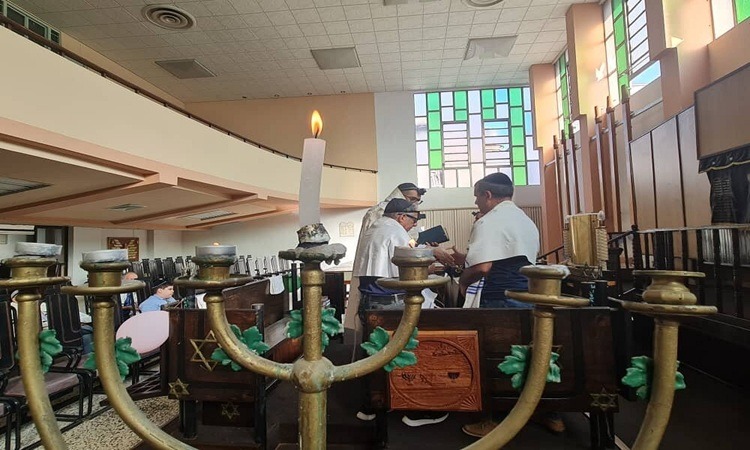
In Havana, refugees established synagogues, Hebrew schools, and social clubs. Sephardic Jews from Turkey joined Ashkenazi newcomers from Poland and Germany. Kosher butchers operated alongside cigar factories. The Patronato community center became a hub of Jewish life.
Although the Cuban Revolution led many Jews to leave, a small but dedicated community remains. Visitors can explore historic synagogues, the Jewish cemetery, and archives that document a unique Caribbean chapter of Jewish survival.
Therefore, Havana tells a story not only of exile, but also of endurance in unexpected places.
Buenos Aires: A Flourishing Jewish Metropolis
Argentina, with its promise of fertile land and urban opportunity, became a beacon for Jewish immigrants in the late 19th and early 20th centuries. Baron Maurice de Hirsch’s philanthropic vision funded agricultural colonies, where families could farm with dignity and build new lives rooted in community and tradition. Over the decades, many of these settlers migrated to Buenos Aires, drawn by the city’s economic possibilities and vibrant cultural life.
Today, Buenos Aires hosts one of the largest Jewish communities outside Israel and the United States, a thriving tapestry of faith, commerce, and culture. Neighborhoods such as Once and Villa Crespo offer a rich Jewish experience: synagogues with Moorish-inspired architecture, kosher bakeries serving traditional pastries, and bookstores filled with Yiddish, Hebrew, and Spanish texts. The rebuilt headquarters of AMIA stands as both a memorial and a testament to resilience, honoring the victims of the 1994 terrorist attack while symbolizing the community’s enduring strength.
Educational and cultural institutions deepen this heritage. The Jewish Museum of Buenos Aires preserves ritual objects, photographs, and personal narratives, while Holocaust memorial sites invite reflection and remembrance. Here, Jewish traditions weave seamlessly into Argentine life: the rhythms of tango mingle with Hebrew melodies, and Spanish carries echoes of Yiddish expressions. Buenos Aires demonstrates that migration does not mean isolation—rather, it fosters integration, creativity, and a living legacy.

Casablanca: Memory and Majesty in Morocco
Casablanca’s Jewish presence dates back over 2,000 years, woven into the city’s economic, cultural, and social fabric. By the early 20th century, Jewish merchants and artisans were central to Casablanca’s bustling markets, trading hubs, and industrial growth. Yet, the mid-20th century saw a profound shift: waves of emigration, largely to Israel and France, transformed the city’s demographic landscape.
Today, Casablanca’s Jewish community is smaller, yet its heritage continues to shine. The majestic Beth-El Synagogue, adorned with intricate Moroccan tilework and carved wood details, stands as a powerful symbol of faith and local artistry. Its sanctuary reflects both religious devotion and the elegance of Moroccan design.
The Museum of Moroccan Judaism offers visitors a rich and comprehensive look at centuries of Jewish life. Ritual objects, archival photographs, and recorded oral histories preserve stories of daily routines, celebrations, and migration journeys. Each exhibit connects the past to the present in a meaningful way.
Across the country, Morocco’s government has taken notable steps to restore Jewish cemeteries, synagogues, and historic landmarks. These efforts ensure that Jewish heritage remains visible and respected.
Visiting Casablanca today, one senses continuity rather than loss. Migration reshaped the community, yet memory, culture, and devotion remain deeply rooted in the city’s identity.
Modern Aliyah and Reverse Diaspora
While millions once left ancestral homes seeking safety, today many Jews journey toward Israel.
Organizations such as The Jewish Agency for Israel and Nefesh B’Nefesh guide new immigrants through housing, employment, and integration. Retirees increasingly choose aliyah for spiritual fulfillment and communal belonging. Young families seek opportunity and connection.
At the same time, reverse diaspora travel continues to grow. Israelis trace Polish ancestry. American Jews rediscover Moroccan roots. Argentine Jews visit Lithuanian shtetls. DNA testing, archival research, and heritage tours now make reconnection easier than ever.
From Memory to Meaning
At its heart, Jewish migration is a story of courage. Families left everything familiar—language, livelihood, landscape—and stepped into uncertainty with faith as their compass. Whether arriving at Ellis Island, building new lives on Manhattan’s Lower East Side, establishing community institutions in Buenos Aires, preserving tradition in Casablanca, or renewing identity through aliyah to Israel, Jewish communities did more than survive. They built. They contributed. They flourished.
Equally important, these journeys reveal how identity adapts without disappearing. Yiddish blended into English on New York streets. Ladino and Arabic are intertwined in North Africa. Hebrew reemerged as a living language in modern Israel. Culture did not fade at the border. Instead, it expanded, absorbing new rhythms while safeguarding ancient roots.
Just as significantly, travel transforms inherited memory into lived experience. When seniors stand in the port halls where their grandparents once waited, history breathes. When families explore synagogues, markets, and memorials together, children grasp that heritage is not abstract, but personal. And when travelers walk through neighborhoods shaped by Jewish resilience, they understand that migration is not merely movement. It is reinvented.
Today, in a world still shaped by displacement and renewal, these routes offer perspective. They remind us that newcomers strengthen cities. They demonstrate that faith and community can anchor even the most uncertain beginnings. And they prove that from the narrow lanes of a shtetl can rise a skyline’s brilliance.
Tracing these migration paths is about looking back. It is about recognizing continuity. Every restored synagogue, every preserved archive, every family story retold keeps the chain unbroken. As travelers follow these footsteps—across oceans, across generations—they do more than visit destinations. They become witnesses to endurance and partners in preservation.
From shtetl to skyline, the journey continues. And with every step taken in remembrance, Jewish life moves forward rooted in history, strengthened by travel, and illuminated by hope.
By Meyer Harroch | New York Jewish Travel Guide

Meyer Harroch is the Founder and Publisher of the New York Jewish Travel Guide, documenting Jewish heritage, life, and culture worldwide while promoting tourism and global destinations.