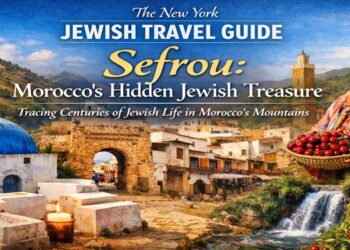
Just thirty minutes from the imperial grandeur of Fez lies a town that feels worlds apart. Yet, the short distance belies the profound difference in atmosphere. Sefrou is not simply a scenic detour or a charming provincial stop. Rather, for Jewish travelers, it is something far deeper: a living archive of Moroccan Jewish civilization, a place once affectionately — and intentionally — called “Little Jerusalem.”


Here, memory is not confined to museums or preserved behind glass. Instead, it rises from stone balconies in the Mellah, echoes in centuries-old tombs, and flows gently with the mountain air descending from the Middle Atlas. In Sefrou, history does not demand attention — it reveals itself quietly. The town is not merely visited — it is felt.
When “Little Jerusalem” Was More Than a Name
In the nineteenth century, Jews in Sefrou outnumbered both Arab and Berber residents. By the late 1800s, nearly half the town’s population was Jewish. The Mellah comprised almost half of the old city — not as a marginal quarter, but as a vibrant intellectual and economic center.
At its height, the Jewish community was dense beyond imagination. In 1948, although numbering fewer than 5,000, Jews lived exclusively within the Mellah, creating one of the highest population densities in Morocco. To adapt, homes were built vertically — three stories high, with wooden balconies overlooking narrow streets. Those balconies remain today, silent witnesses to a once-thriving world of Torah scholarship, artisan guilds, and communal life.
Sefrou’s Jews traced their roots to the Tafilalet and Debdou regions. They were master artisans — working copper, silver, gold, and leather — alongside weaving, carpentry, timber trade, and commerce. Their craftsmanship linked Sefrou to trade routes stretching deep into the Sahara.
Remarkably, after Morocco’s independence, a rabbi from Sefrou was elected to Parliament — a powerful symbol of civic integration and respect.
A Town of Three Faiths
Sefrou has long been known for its spirit of coexistence. For centuries, Jews, Muslims, and Christians shared not only streets but seasons of celebration, weaving a culture rooted in mutual respect.
That spirit was beautifully captured by the revered Sufi Sheikh Abdelkader Timouri, who praised the town’s beauty and harmony during its beloved Cherry Festival, writing:
“That you are Jewish, Christian, or Muslim,
The inhabitants of this city welcome you with open arms.”
In his verses, he described Sefrou’s gardens, waterfalls, and cherries as blessings — and invited visitors to ascend the hill at dawn to receive the baraka of Saint Sidi Ali Bousserghine.
Every mid-June since 1920, Sefrou has celebrated its Cherry Festival — today recognized by UNESCO as part of Morocco’s intangible cultural heritage. However, long before international recognition, it stood as a symbol of shared civic pride and interfaith harmony — a reflection of the town itself.

The Jewish Cemetery: Where Generations Return
The Jewish cemetery of Sefrou, spanning nearly four hectares and dating back at least 500 years, is among Morocco’s most moving sacred sites. Restored with funds from émigré families, its historic headstones have been mounted within protective cement monuments.
More than a burial ground, it is a pilgrimage destination.
Each year — especially during the Hiloula (the anniversary of a rabbi’s passing) — Jewish visitors from Morocco, France, Israel, Canada, and beyond return. Attendance can exceed 1,000 annually. Many come solely to visit “Little Jerusalem,” maintaining a bond that distance has never erased.
Among the revered sages buried here:
- Rabbi Moshe Elbaz, known as the “Master of the Grotto,” whose spiritual reputation extended far beyond Sefrou into Tafilalet and across Morocco. His Hiloula draws devoted pilgrims seeking blessing and reflection.
- Rabbi Shalom Ben Attar, known as the Or HaChaim (“Light of Life”), was a towering scholar and kabbalist whose teachings continue to illuminate Jewish thought.
- Rabbi Yacoub Chamoune Hammou, a respected rabbinic figure of the Mellah.
Monuments within the cemetery also commemorate 21 Jewish victims of the devastating 1950 flood and merchants who perished in a tragic truck accident en route to the Tafilalet region — reminders that communal memory includes both glory and grief.
Maintenance of the cemetery remains a collective effort. The Jewish committee in Fez coordinates annual upkeep, supported by descendants who fund restoration, wall expansion, and even modest housing to accommodate pilgrims during Hiloula gatherings.
For Jewish travelers exploring Morocco, visiting Sefrou’s cemetery is not tourism. It is continuity.
The Orphanage and the Echo of Community Care
Just beyond the Mellah stands a large but now-vacant complex that once housed a Jewish orphanage and school, administered by the Moroccan organization Em Habanim and funded by the London Jewish community. Within its walls sits a simple synagogue — understated, dignified, and profoundly symbolic of the communal structures that once flourished here.
It is a quiet space, but its silence speaks.

A Different Moroccan Experience
While cities like Marrakech dazzle and Fez overwhelm with medieval intensity, Sefrou offers something rarer: emotional clarity. The medina is navigable, the streets unhurried, the conversations unforced.
You will hear water from the Oued Aggay river as it threads through town. You will notice carved Stars of David still etched into aging doorframes. You will feel that this was not a peripheral Jewish outpost, but a central chapter of Moroccan Jewish life.
For travelers tracing Jewish heritage in Morocco, Sefrou provides context. It demonstrates how deeply integrated, influential, and spiritually vibrant Moroccan Jewish communities once were — not only in major capitals, but in smaller towns that carried immense cultural weight.
For Jewish travelers, Sefrou offers a rare opportunity to understand Moroccan Jewish life beyond the well-trodden paths of Casablanca and Fez. Here, you can visit one of the country’s most significant Jewish cemeteries and pilgrimage sites, where you can stand among the graves of revered rabbis whose teachings continue to inspire generations. Walking through the cemetery, you hear the whisper of the wind over centuries-old headstones, feel the cool shade of cypress trees, and sense the weight of history carried in every carefully restored monument. Each year, particularly during the Hiloula, families from Morocco, Israel, France, Canada, and beyond arrive with quiet determination, carrying offerings of candles and heartfelt prayers. At that time, the cemetery becomes not only a place of remembrance but also of reunion. Generations gather side by side in a powerful display of continuity. Children follow in the footsteps of their grandparents, carefully tracing the same paths pilgrims have walked for decades. Elders pause to share stories of miracles and blessings once received at these sacred tombs. In this way, memory is not simply preserved — it is actively passed down. The Hiloula becomes more than a commemoration; it becomes a living bridge between past and present.
The town provides a living example of Muslim–Jewish coexistence rooted in centuries of daily life, where neighbors once shared streets, festivals, and marketplaces, and where traditions of respect and friendship transcended religious boundaries. Wandering through the Mellah, you can almost hear the murmur of Shabbat prayers and see balconies once filled with families gathering for Sabbath meals, their laughter mingling with the scent of cedar, spices, and fresh-baked bread drifting through the narrow alleys. Here, the past is tangible: carved Stars of David still adorn old doorways, wooden shutters echo with memory, and the quiet rhythm of daily life — women sweeping steps, merchants arranging goods, children playing — tells a story as vivid as any history book. Sefrou allows visitors to reconnect with ancestral memory in a setting that remains intimate and unassuming, yet profoundly moving.
The town does not merely invite observation; it invites participation. You can cross its bridges over the Oued Aggay, hearing water rush and sparkle as it has for centuries. You can wander among cherry orchards and lush gardens, feeling the warm sun on your face and inhaling the sweet fragrance of ripening fruit, imagining the same scenes celebrated during the famous Cherry Festival for over a hundred years. During Hiloula or pilgrimage visits, travelers often pause to share a cup of mint tea with locals who remember the Jewish community fondly, recounting tales of rabbis like Moshe Elbaz, the Master of the Grotto, whose blessings were said to bring health and guidance. Visitors describe an overwhelming sense of connection, as if the town itself remembers and welcomes them, bridging centuries of absence with gestures of hospitality.

Sefrou does not shout for attention. It invites.
It invites you to walk slowly through a Mellah that once pulsed with Torah study, artisans hammering copper and silver, and merchants trading across the Sahara. It invites you to stand before weathered headstones and whisper the names of sages whose teachings still resonate across continents. It invites you to pause on a balcony or along a quiet street and feel the pulse of daily life — the clink of teacups, the laughter of children, the murmur of neighbors exchanging greetings — and sense that here, history is not just remembered, it is lived.
For descendants of Moroccan Jewry, Sefrou is not simply a destination — it is a return. For Jewish travelers discovering Morocco for the first time, it is a revelation: a reminder that Jewish history in North Africa was not peripheral, but central, creative, and deeply rooted. Here, heritage is not performed for visitors. It rests in restored cemeteries, in preserved monuments, in orchards and rivers, and in the enduring respect of neighbors who remember.
Morocco’s imperial cities may impress you.
Sefrou will move you.
And long after you leave its quiet streets, the scent of cherries, and the cool mountain air behind, you may find that “Little Jerusalem” has followed you home — carried not in photographs or souvenirs, but in spirit, in memory, and in the shared stories of pilgrims who return year after year, bridging past and present, and keeping the heart of Sefrou alive.
By Meyer Harroch | New York Jewish Travel Guide
Meyer Harroch is the Founder and Publisher of the New York Jewish Travel Guide, documenting Jewish heritage, life, and culture worldwide while promoting tourism and global destinations.